Tập tin:Solar System scaled to football field.png


Miêu tả
| Miêu tả |
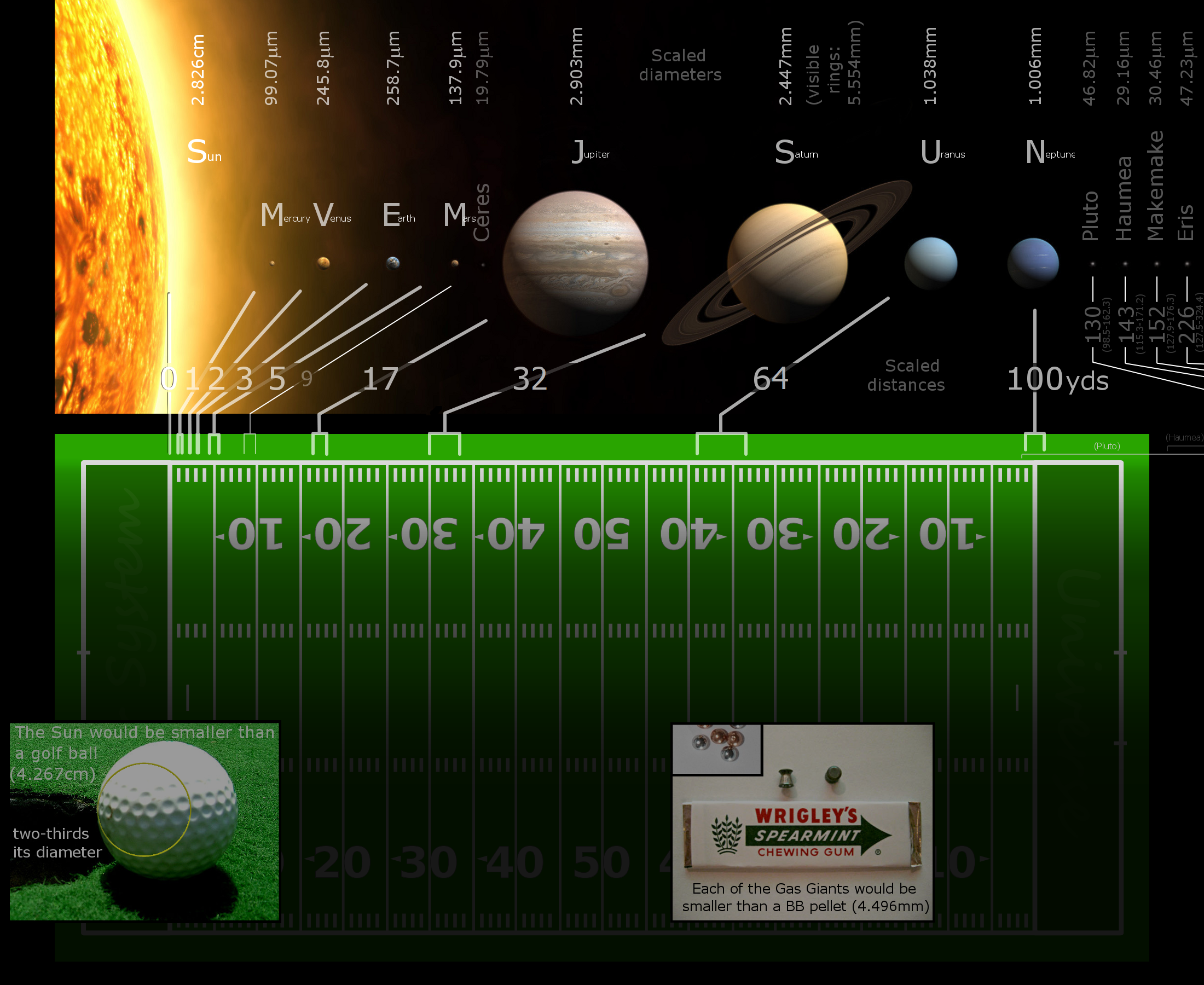
English: This image shows the Solar System with its eight planets and its five known dwarf planets in relation to the Sun, with sizes drawn to scale, and with distances marked to scale along an American football field of 100 yards (goal line to goal line, roughly 13 meters shorter than a standard soccer, or Association football field) from the Sun to the farthest planet, Neptune. At this scale, the Sun would have two-thirds the diameter of a golf ball (2.826cm versus 4.267cm). The gas giants are an order of magnitude smaller, and all four would be smaller than a BB pellet, at 4.496mm (.177 cal). Jupiter, the largest planet, scales down to 2.903mm. However, Saturn's rings at 5.554mm, would cover a BB.
All 14 objects are spotted at their scaled yardage along the gridiron, with pointers toward the location of Pluto and the other outer dwarf planets far off to the right of the field. The distances are labeled in whole yards, with brackets identifying the span of their elliptical orbits (Pluto's perihelion is shown to take it onto the playing field just inside of Neptune's orbit). At the top of the chart is a list of the diameters of each body as they would be found when shrunk down to this gridiron scale. The exact scale factor is 49,250,000,000-to-1. Precise numbers for the orbit distances as a percent of Neptune's mean distance are (Mercury through Neptune respectively): 1.287%, 2.402%, 3.323%, 5.063%, 17.292%, 31.712%, 63.786%, and 100%. The terrestrial planets are an order of magnitude in size lower than the gas giants, and the dwarf planets one more order of magnitude lower still, generally speaking. While the field itself may seem like vast emptiness, this only represents one section of the solar system as the planets orbit all the way around the Sun. And this representation of the ecliptic plane is only the one slice where such objects are found, while the entire three-dimensional volume includes the vast emptiness above and below this plane. The most distant probe ever sent from the Earth is Voyager 1. On Aug 25, 2012, at a distance of 121 AU, it's sensors detected a transition across the heliopause and it is now understood to be in interstellar space. At the scale of this image, that transition happened at a distance of 402 yards away from the Sun (another 3 football field lengths away). NOTE: The direction of lighting onto the planets is not accurately represented, as the Sun is diagrammed on the left. A total of five Wikicommons images were combined to create this image, which was made using GIMP image editing software.
 File:SunMercuryVenusEarthMoon-Rockets full-court.png |
| Ngày | |
| Nguồn gốc | |
| Tác giả | Tdadamemd |


Giấy phép


- Bạn được phép:
- chia sẻ – sao chép, phân phối và chuyển giao tác phẩm
- pha trộn – để chuyển thể tác phẩm
- Theo các điều kiện sau:
- ghi công – Bạn phải ghi lại tác giả và nguồn, liên kết đến giấy phép, và các thay đổi đã được thực hiện, nếu có. Bạn có thể làm các điều trên bằng bất kỳ cách hợp lý nào, miễn sao không ám chỉ rằng người cho giấy phép ủng hộ bạn hay việc sử dụng của bạn.
- chia sẻ tương tự – Nếu bạn biến tấu, biến đổi, hoặc tạo tác phẩm mới dựa trên tác phẩm này, bạn chỉ được phép phân phối tác phẩm mới theo giấy phép y hệt hoặc tương thích với tác phẩm gốc.
Lịch sử tập tin
Nhấn vào ngày/giờ để xem nội dung tập tin tại thời điểm đó.
| Ngày/Giờ | Hình xem trước | Kích cỡ | Thành viên | Miêu tả | |
|---|---|---|---|---|---|
| hiện tại | 05:16, ngày 22 tháng 3 năm 2013 | | 2.200×1.800 (1,6 MB) | wikimediacommons>Tdadamemd | Visually quantifying that the Sun scales down to two-thirds the diameter of a golf ball. |
Trang sử dụng tập tin
Trang sau sử dụng tập tin này:
